interview with Grace Dilger
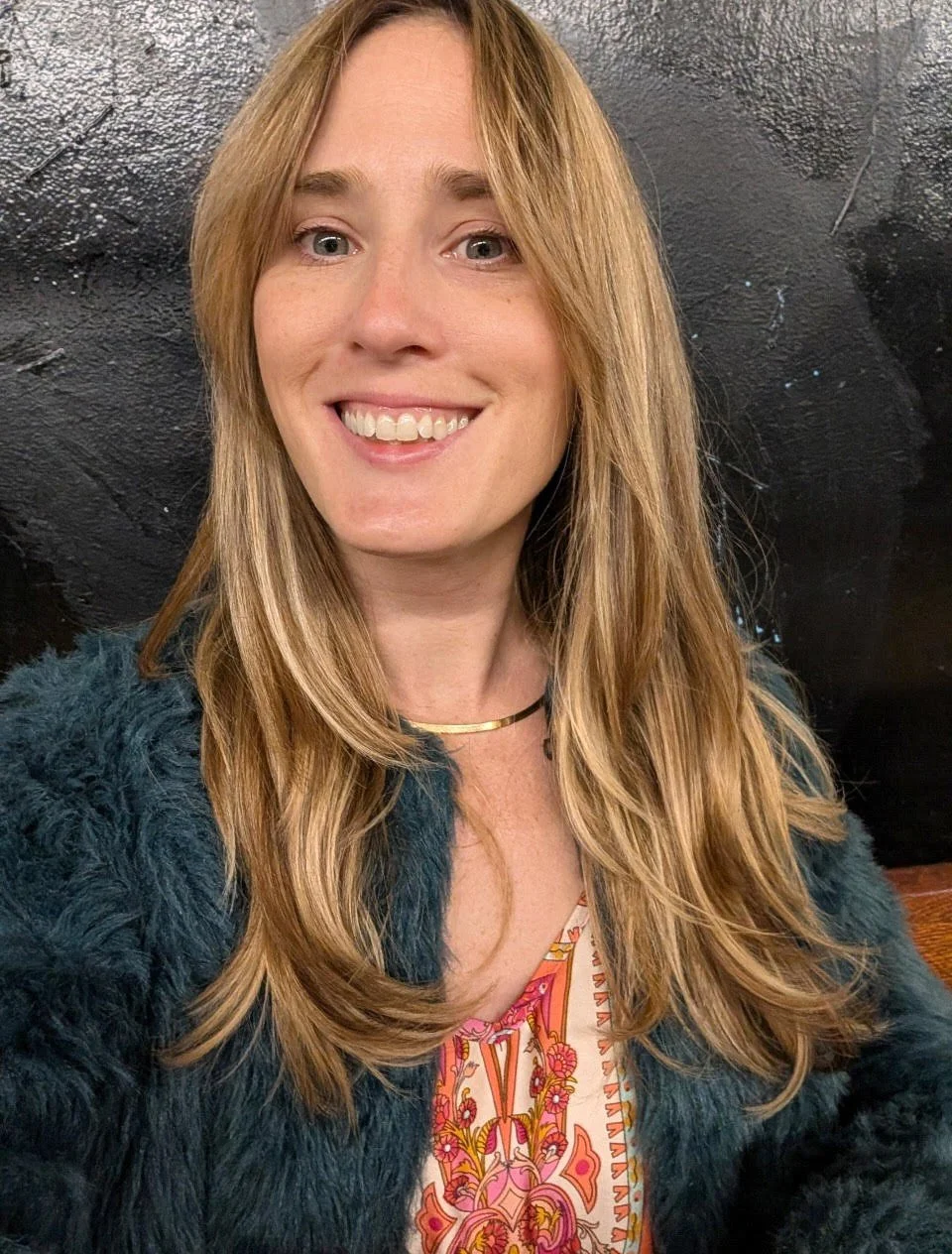
Grace Dilger is a poet and educator. Her work has most recently appeared in The McNeese Review, Barzakh, The Nonbinary Review, The Bangalore Review, Palisades Review, and Okay Donkey. She received her MFA from Stony Brook University and teaches at Monroe University where she is the recipient of the 2025-2026 Conrad Goldberg Excellence in Teaching Award.
Grace Dilger’s poetry explores the ways we love, mourn, desire, and survive alongside one another. Blending humor, grief, intimacy, politics, and everyday life, her work finds emotional depth in the ordinary. Dilger writes with a restless intelligence, weaving together unexpected facts, pop culture, family lore, and communal memory to create poems that feel both deeply embodied and intellectually alive. At once irreverent and tender, her poems embrace contradiction, vulnerability, and the fragile connections that sustain us, resulting in work that is witty, compassionate, and profoundly human.
We interviewed Grace about her piece, Whatever Comes Next, published in The Palisades Review. Read that story here and read her interview below.
TPR: Your poem, “Whatever Comes Next,” moves between intimate memories and public facts, including the unsettling reality that the subject's death was recorded and circulated online. How did you decide what to include and what to leave unsaid?
Grace: I was really angry when I wrote this, really devastated at the dehumanizing, and in this case, politicized, rhetoric around a deeply personal tragedy for my community. When a friend’s death is also a news story, you don’t want to inadvertently contribute to that public discourse their family and loved ones have not consented to, right? I wanted to center my friend, his light and his depth and dimensions. It’s also an imagining of what could have been, which is what we tend to focus on when someone dies suddenly. It feels true to life in that way.
TPR: One of the poem's most striking qualities is the way it accumulates details like Haribo worms, Narragansett cans, hydrangeas, and a bus ride home. How do small, specific images help you approach subjects as large as grief and loss?
Grace: That’s the stuff of life right? The proverbial poet’s eye is really just a penchant for detail, the glimmering surfaces of the world as one poet put it. I can say he was really a New England guy at heart or I can say Narragansett cans and hydrangeas–one is more immediately transportive for me than the other.
TPR: The poem is filled with direct addresses to "you." What does the second person allow you to do emotionally that another perspective might not?
Grace: I’m a slut for the 2nd person, am I allowed to say that? It’s a permission structure to engage in direct dialogue with a person, a time, a memory that the laws of physics generally ban us from.
TPR: There is a profound sense of community throughout the piece like a network of poets, activists, and friends. How important was it to you that the poem memorializes not just an individual but a collective?
Grace: The most important thing, I’d say. Because my friend, Ryan, was a community advocate and dogged activist to the 10th degree. The art that has been made in this man’s name, let me tell you. Mutual aid, love, support, tenacious and unapologetic outrage permeate all of it. And humor. He was funny as hell. We’re all laughing at the end of the world, but we’re pissed AF too. Educate, organize, agitate. And fill your cup with the people you love in-between. It’s a love poem in that way too, to a community of care.
TPR: The poem's spacing and lineation create pauses that feel both conversational and destabilizing. How did you develop the visual shape of the poem?
Grace: She needed to breathe. A sudden passing creates a vacuum and knocks the air right out of you. I wanted to aerate this piece to both restore that loss of breath and to try to capture that gasping that comes with the gut punch of grief.
TPR: What role does poetry play for you when confronting events that feel impossible to understand or accept?
Grace: It’s integral to me. I still remember writing this poem at a coffee shop in such a fog. It chokes me up thinking about it now how battered we all were. I struggled with confronting my personal grief, thinking of my friend’s family, his partner, his closest friends and feeling so devastated for them. I was able to give myself the space I needed to start to process his death in a really personal sense through memorializing him in this way.
TPR: Are there poets or writers whose approaches to elegy have influenced your own work?
Grace: Oh goddess, yes. A one Louise Elizabeth Glück. Ariana Reines. Katie Condon’s Praying Naked, is a collection I felt seen by recently, and have been sharing with friends. Franny Choi. Chet’la Sebree. I read Geraldine Brook’s memoir, Memorial Days this year and it knocked me on my ass. Very unoriginal for me to say Didion’s The Year of Magical Thinking but it’s a touchstone.
TPR: Is there a line or image in this poem that surprised you when it arrived? Something that taught you what the poem was really about?
Grace: I think Ryan would have feigned a pearl clutch at the idea of his signature hair as an improvised explosive device, instruments of war he was perpetually railing against. That sort of delights me in a morbid way. Normally I figure out what it’s about along the way, but that wasn’t really the case in this unique set of circumstances.
TPR: What advice would you give writers who want to write about loss without reducing the complexity of the person they're writing about?
Grace: My friend was a brilliant poet, so I have that advantage of knowing this written tribute would please him. The title actually I borrow from a poem he wrote for another friend of ours who went before him. So I had a strange, dark but ultimately beautiful continuum of loss I was writing in. And I say beautiful because we cannot control who we lose but we can control how we show up for each other and that doesn’t end even when your life does. That brings me some peace. Ultimately, I don’t think you should write the dead any differently than the living. No one deserves to be reduced. Let your poems be as multidimensional as your subject. We’re such complex creatures, I think our poems should reflect that even and especially, in death.
Grace Dilger